← Back to portfolio | View public optimizer subset on GitHub
Overview
Strategy Assayer is an ML evaluation and provenance framework. Search finds candidates. Evaluation decides whether they are real. A result that only looks good because many variants were tried does not clear the gates: walk-forward holdout, randomized control arms, null distributions, multiple-trial correction, blocking promotion rules, and hash-stamped run records (plan hash, code SHA, engine version).
Underneath that is a parallel experiment orchestration engine: compile once, warm
worker pools, a persistent harness, and directed search (genetic, Latin Hypercube,
Bayesian/Optuna TPE, local grid). The expensive tests are routine because the engine
makes them cheap. The evaluation workload is QuantConnect LEAN. The public
lean-optimizer-public repository exposes the orchestration-engine slice;
the private platform adds the evaluation and promotion pipeline.
Measured Optimizer Performance
Public optimizer benchmark against the engine CLI's built-in exhaustive grid search on a 7-parameter space (679,140 grid points), 15 parallel workers, same workload, same data:
| Exhaustive grid (CLI baseline) | lean-optimizer (GA) | |
|---|---|---|
| Search strategy | Exhaustive grid (all 679,140 points) | Incremental genetic algorithm |
| Evaluations | 679,140 | 611 |
| Throughput (15 workers) | 2.15 evals/sec | 3.82 evals/sec |
| Wall time | ~88 hours (extrapolated from 1,772 evals in 825s) | 2 min 40 sec |
| Search efficiency | 1x | 1,112x fewer evaluations |
The two advantages are independent and compound: the persistent harness yields ~1.8x higher throughput per worker, and the GA's directed search converges in 1,112x fewer evaluations. Combined: what takes the CLI grid search an estimated ~88 hours completes in under 3 minutes. I do not claim a measured multiplier for the full private walk-forward evaluation pipeline; that is described qualitatively as a move from one-off runs to an automated credibility pipeline.
Evaluation and Promotion Pipeline
The private platform spans the full experiment-to-promotion loop:
- Data ingestion and backfill
- Workload packaging and experiment ports
- Parameter-space definition through YAML experiment plans
- GA, grid, and Bayesian parameter search
- Out-of-sample evaluation on held-out windows
- Walk-forward credibility scoring
- Graduated verdicts with absolute floors
- Composition and sizing
- Forward prediction bands and kill-lines
- Parameter-staleness monitoring
- Dashboard review and manually approved promotion packages
- Post-promotion monitoring from the fill ledger
Validation Discipline
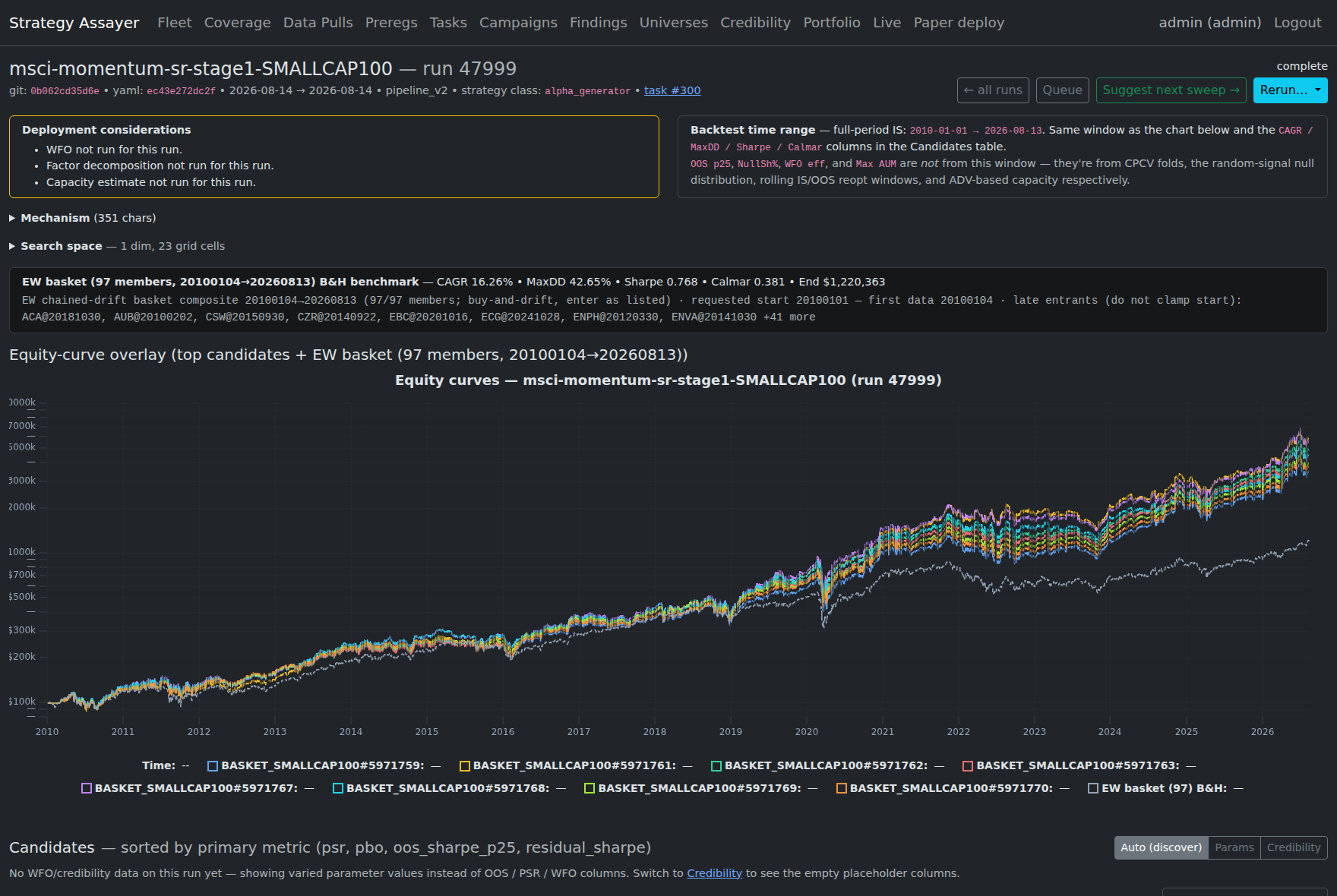
The platform is intentionally conservative. It has scored 11 experiment families across 350+ evaluation tasks with full credibility verdicts, drawing on a corpus of more than 25,000 experiment plans, 86,000 walk-forward windows, and 5.2 million individual evaluation runs. Verdicts are graduated quality scores (0–10, banded from strong to poor) with absolute floors: a candidate that breaches the floors is blocked outright, regardless of how well it scores elsewhere. Of 1,693 scored runs, 435 were blocked. Promotion is the exception; preventing attractive but fragile evaluations from shipping is the system's purpose.
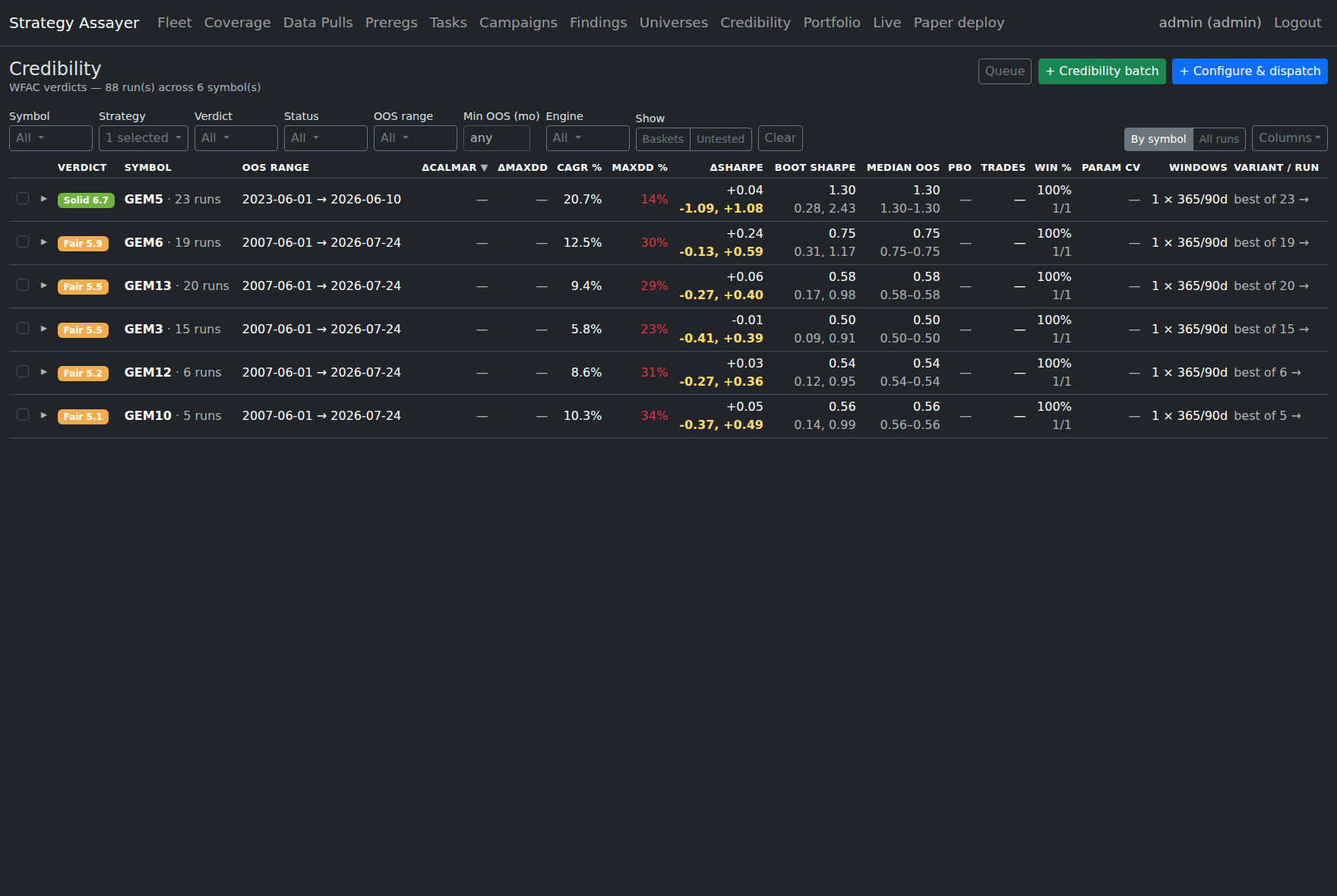
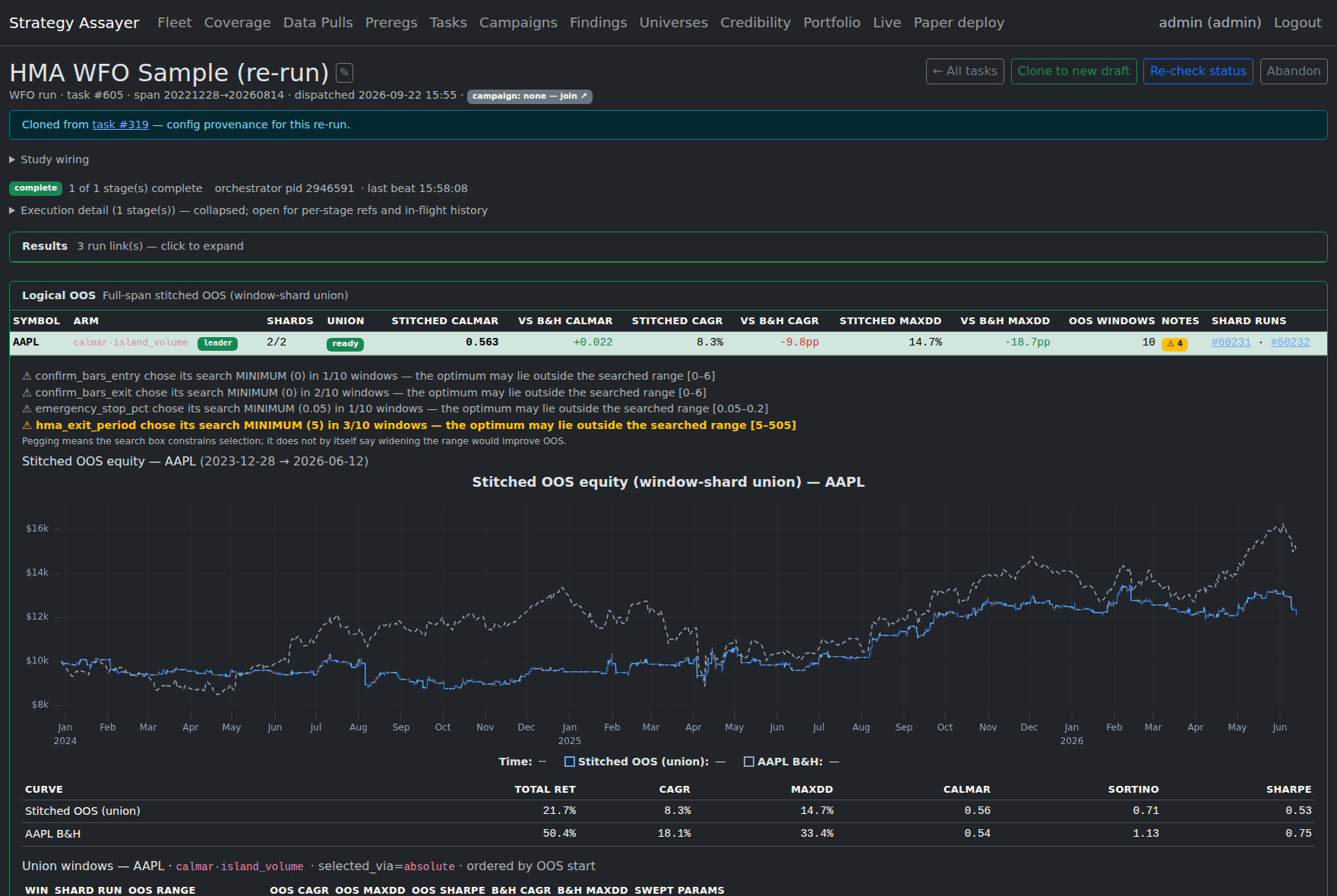
Scoring is walk-forward and baseline-relative. Every candidate is judged on stitched out-of-sample performance from a walk-forward loop whose re-optimization schedule mirrors how it would actually be re-tuned in production, and the headline metric has to beat the do-nothing alternative, not just look good in isolation. Statistical credibility checks - multiple-trial correction, combinatorially purged cross-validation, bootstrap confidence intervals, probability of selection overfitting - are computed and persisted as diagnostics and guardrails rather than verdict inputs, accumulating until live outcomes allow them to be calibrated against realized results.
The strongest guardrail is a randomized-control null distribution: the complete walk-forward loop is re-run dozens of times with the signal replaced by seeded random entries, measuring whether the optimization process can manufacture an equally attractive result from pure noise. Distributed across the compute fleet through the shared work queue, a 50-seed null distribution completes in about two minutes, making the test routine rather than prohibitive.
Production behavior is then compared against a pre-committed forward expected distribution rather than against in-regime evaluation headlines.
Experiment Orchestrator
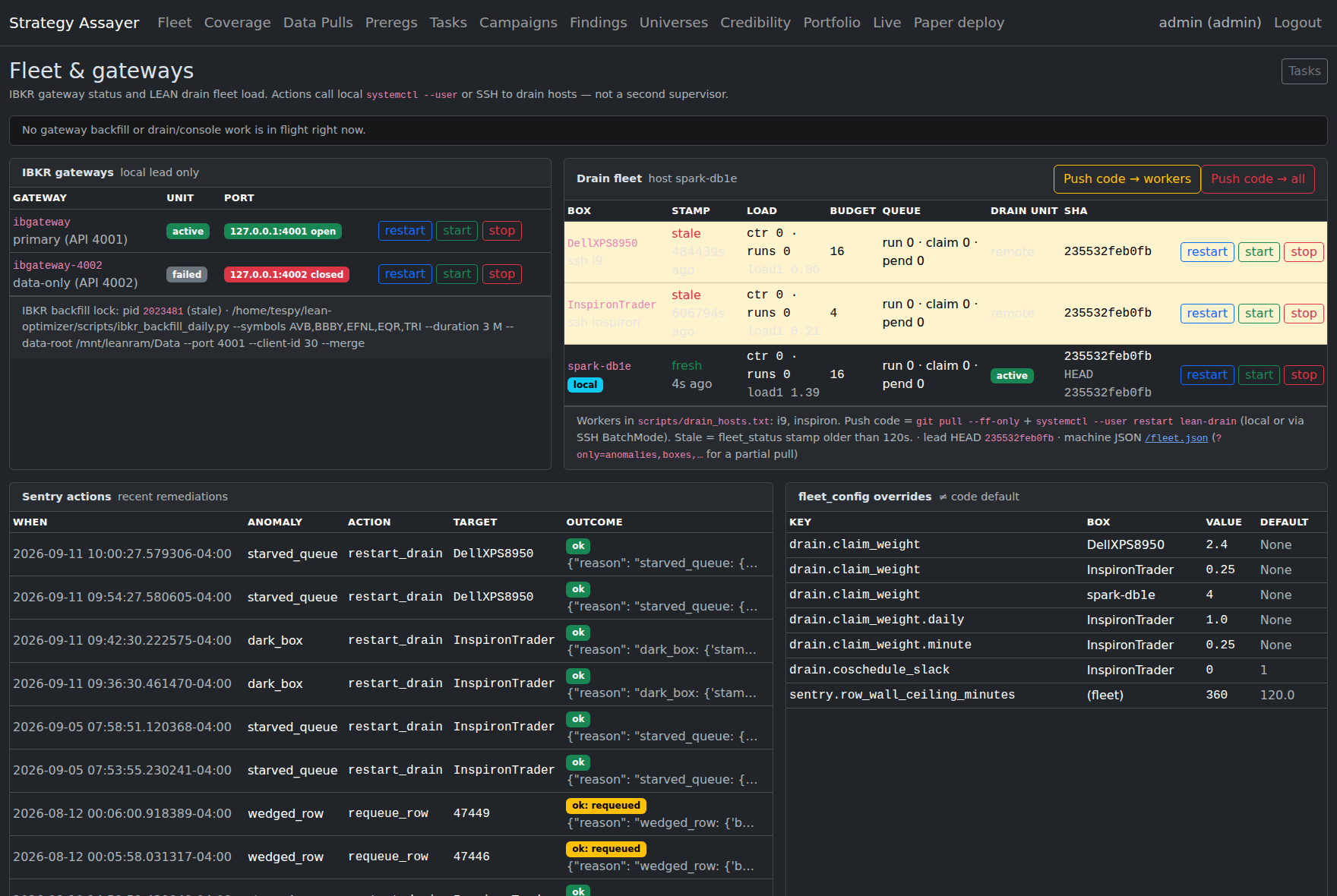
The platform includes a service-based experiment orchestrator outside the main web UI. It can run the evaluation chain unattended for days: data pre-flight, download, Discover, parameter-range validation, walk-forward bake-off, credibility promotion, composition, and packaged evaluation. The orchestrator interleaves throttled data downloads with otherwise-idle research compute, dispatching each task's evaluation once its data is ready.
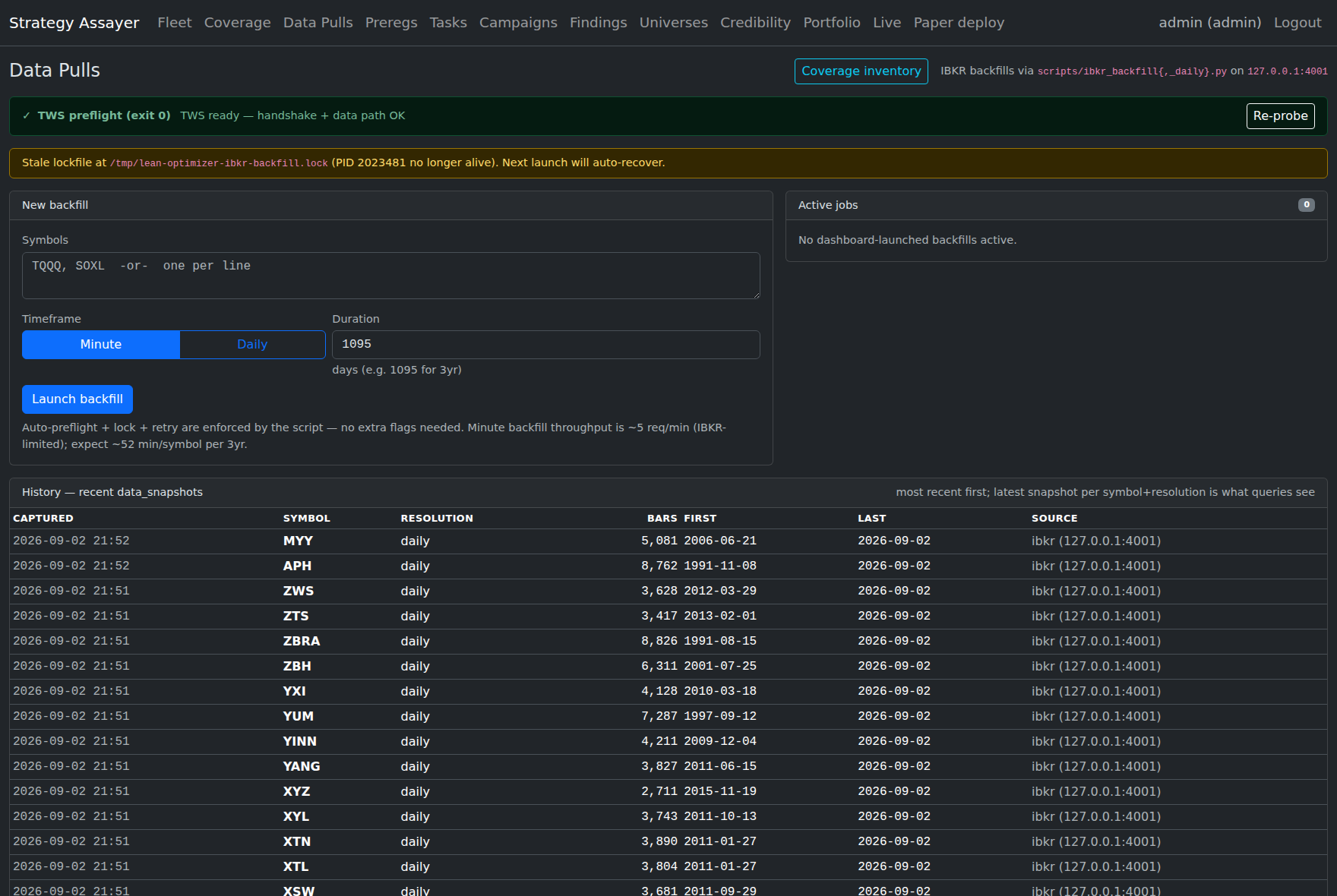
A bounded evaluation steward runs as a separate LLM-guided layer. A deterministic queue runner keeps evaluations running from a curated backlog; the LLM steward periodically reads results, writes findings, and queues the next experiments. Its trust boundary is deliberately narrow: it can read and call a restricted steward CLI, but has no raw shell, write, git, database, or production-promotion access.
Experiment orchestration is distinct from production promotion. Evaluation can run unattended; promotion remains gated by dashboard review and manual operator approval.
Persistent Harness
The public optimizer's core innovation is the persistent .NET harness. Each Docker container runs a
long-lived dotnet /Harness/LeanHarness.dll process that reads JSON requests from stdin,
runs evaluations with full engine state reset between runs, and writes JSON responses to stdout. This
eliminates per-eval .NET startup, assembly loading, and engine initialization overhead.
The harness uses the engine's regression-test reset sequence:
Config.Reset(), Composer.Instance.Reset(),
SymbolCache.Clear() - the same sequence the engine's own test suite uses to run multiple
evaluations in one process. Console.Out is redirected to stderr so trace/debug output
does not corrupt the JSON protocol.
Engineering Controls
- Tests: 5,400+ private test functions across 454 files; 130 tests in the public optimizer subset.
- ADRs: 99 architecture decision records document durable design choices.
- AI-assisted development: Claude Code accelerated implementation, but architecture, validation methodology, deployment controls, tests, and operational ownership remained human-owned.
- Manual promotion gate: production promotion is never autonomous.
- Bounded LLM access: the evaluation steward cannot write code, modify the database, use git, or access promotion controls directly.
- AI-assisted delivery: bounded implementation work is increasingly routed through the same evidence-first controls described in the AI Engineering methodology and implemented in Ratchetloop: explicit scope, executable gates, independent review, and human promotion.
Background
The genetic algorithm at the core of lean-optimizer is the same class of algorithm I developed at Togai InfraLogic, where my research in fuzzy logic and genetic algorithms was published at IEEE and NASA conferences. Today, the same optimization principles run inside a modern evaluation-infrastructure stack.
Tech Stack
- Python 3.12, Optuna, NumPy, SciPy, pandas
- C# / .NET, persistent evaluation harness
- Docker, warm worker pools, read-only data mounts
- FastAPI, Jinja2, HTMX, Bootstrap
- Systemd user timers, service-based experiment orchestration
- NVIDIA DGX Spark: 20-core ARM CPU, GB10 GPU, 128GB unified RAM
Generated output stats available on request.